
5 Invoicing Mistakes Contractors Make (And How to Fix Them)
Not tracking admin time, rounding down, delayed invoicing, no detailed breakdown, inconsistent rates — these mistakes cost contractors thousands. Here's how time data prevents each one.
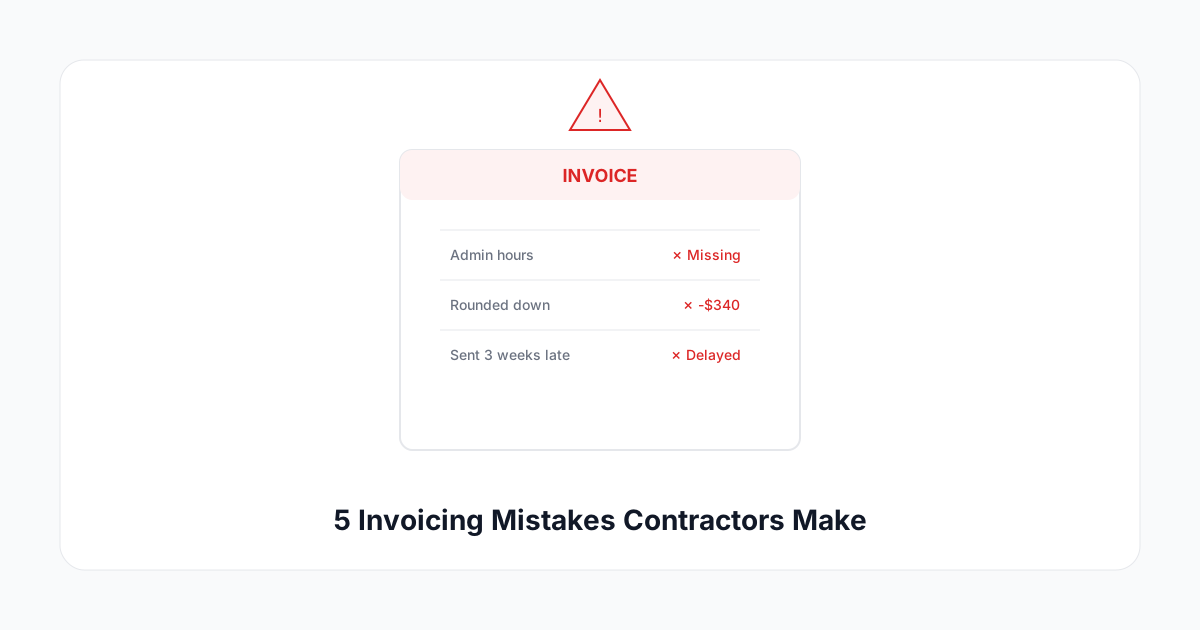
5 Contractor Invoicing Mistakes That Are Costing You Thousands
You finished the project, sent the invoice, got paid. Everything looks fine — except you left $400 on the table. Again. Not because the client cheated you, but because your invoicing habits have tiny leaks that compound into serious money over a year. Most contractors don't have a revenue problem. They have a revenue capture problem. Here are five invoicing mistakes that quietly drain freelance income, and how time data fixes each one.
Mistake #1: Not Tracking Administrative Time
You spent 45 minutes on a client call, 20 minutes writing a project brief afterward, 15 minutes organizing their assets in your file system, and 10 minutes updating your project management tool. None of that made it onto the invoice.
This is the most universal invoicing leak. Contractors bill for "the work" — the design, the code, the writing — but treat everything around it as free overhead. It's not overhead. It's work the client's project requires.
The real cost: If you spend 5 hours per week on unbilled admin across all clients, at $100/hour that's $2,000/month — $24,000/year — that you're donating.
How time data prevents it: When you track all time associated with a client (not just the deliverable work), you can see exactly how much admin each project generates. From there, you have options:
- Bill admin time directly (many clients expect it — they just want transparency)
- Build it into your project rate (if 20% of project time is admin, your project quotes increase 20%)
- Set a minimum billing increment that absorbs small admin tasks (e.g., 15-minute minimum per entry)
You can't bill what you can't see. Start seeing it.
Mistake #2: Rounding Down
"It was probably about 2 hours." No — it was 2 hours and 22 minutes. But you rounded down because 2 hours felt cleaner, or because you didn't want to seem like you were nickel-and-diming.
Here's the thing: you never round up. Nobody sends an invoice for 2.5 hours when they worked 2 hours and 8 minutes. The rounding only goes one direction, and it always favors the client.
The real cost: Rounding down by an average of 15 minutes per task across 3 tasks per day, 5 days per week = 3.75 hours/week. At $100/hour, that's $1,500/month you're voluntarily not charging.
How time data prevents it: When you have exact timestamps, there's nothing to round. Your invoice says 2.37 hours (or 2 hours 22 minutes) because that's what the data shows. Most clients don't blink at precise numbers — in fact, they trust precise invoices more than round ones because precision signals professionalism and accurate record-keeping.
Set your billing increment (6 minutes, 15 minutes, whatever your contract specifies) and round to that consistently. Up or down, following a clear rule — not your gut feeling about what seems "fair."
Mistake #3: Delayed Invoicing
You finished the project two weeks ago but haven't sent the invoice yet. Maybe you're waiting until the end of the month to batch invoices. Maybe you just forgot. Maybe the project ended ambiguously and you're not sure if there's one more round of revisions coming.
Delayed invoicing is expensive in ways most contractors don't realize:
- You forget billable time. The longer you wait, the more small entries slip through the cracks. That 30-minute call on day 3? Gone from memory by week 3.
- Clients forget context. An invoice that arrives weeks after the work prompts questions. "What was this 2 hours for?" Now you're spending unbilled time justifying the bill.
- Cash flow suffers. If you invoice 2 weeks late and payment terms are net-30, you're waiting 6+ weeks to get paid for work you did today.
- It signals low priority. Clients who receive invoices like clockwork pay faster than clients who receive them sporadically.
The real cost: A combination of forgotten hours (estimate 1-2 hours per delayed invoice) and extended payment cycles that strain your cash flow.
How time data prevents it: When your time is tracked in real-time, your invoice is essentially pre-written. At the end of a project (or billing period), you export your time entries, add any fixed-fee items, and send. No reconstruction, no memory archaeology, no "let me check my calendar to see when we had that call."
The faster you invoice, the more accurate and less contested your invoices are. Aim for same-day or next-day invoicing after a project completes or a billing period ends.
Mistake #4: Invoices Without Enough Detail
"Consulting services — 40 hours — $4,000."
That invoice will get paid. But it's also the invoice most likely to get questioned, negotiated down, or paid slowly. It gives the client no way to verify the work, no visibility into where their money went, and no confidence that the number is accurate.
Detailed invoices get paid faster and questioned less because they demonstrate value. The client can see exactly what they received for their money.
The real cost: Vague invoices increase payment delays (clients sit on them longer when they can't quickly verify), increase disputes (which eat your unbilled time), and make rate increases harder to justify (the client has no breakdown showing the complexity of what you do).
How time data prevents it: With tracked time entries, your invoice naturally includes:
- Date of work
- Description of what was done
- Duration per task
- Category (development, communication, revision, etc.)
Compare these two line items:
❌ "Website development — 8 hours"
✅ "Aug 5: Homepage hero section build + responsive breakpoints (3.5h) | Aug 6: Contact form integration + validation (2.5h) | Aug 7: Client feedback revisions — header layout + CTA color (2h)"
The second version communicates professionalism, justifies the hours, and makes the client feel informed rather than suspicious. It also protects you if a client ever disputes scope — you have a timestamped record of exactly what was delivered.
Mistake #5: Inconsistent Rates Across Projects
You quoted Client A $120/hour six months ago. Client B got $100/hour because you were hungry for work. Client C is on a project rate that works out to $85/hour based on how long it actually took. And Client D is on a retainer that you haven't recalculated since you signed it a year ago.
Rate inconsistency is natural — every freelancer accumulates it over time. But without tracking, you can't see it, and you can't fix it strategically.
The real cost: If your lowest-paying client takes up 40% of your time, your blended rate is being pulled down significantly. You might average $95/hour across all clients when your target is $120.
How time data prevents it: Monthly or quarterly, pull your effective rate per client:
Total revenue from client ÷ Total hours (including unbilled) = Effective rate
Rank them. Now you can see:
- Which clients are below your minimum acceptable rate
- Which clients have drifted down over time (scope grew, rate didn't)
- Where a rate conversation or contract renegotiation is overdue
- Which clients you'd replace first if new work came in
This isn't a one-time exercise. Rates drift constantly as projects evolve, scope expands, and your skills increase. A quarterly rate review based on actual time data keeps you from accidentally working below your floor.
The Compound Effect
Any one of these mistakes costs you $1,000-2,000 per month. Combined, they can easily account for $5,000-8,000 in leaked revenue — annually, that's $60,000-96,000 left on the table. Not in theory. In actual hours worked but not billed, actual value delivered but not captured.
The fix for all five is the same: track your time consistently and let the data inform your invoicing. Not as a chore. As a financial tool that pays for itself many times over.
Start with your next project. Track everything — the work, the emails, the calls, the admin. When the invoice goes out, let your time data write it. You'll bill more accurately, get paid faster, and finally see the full picture of what your work is actually worth.