
The Hidden Tax of Context Switching (And How Your Time Data Reveals It)
Context switching quietly eats up to 40% of your productive time. Here is how your own time data reveals where your focus fractures — and how to reclaim it, without the surveillance.
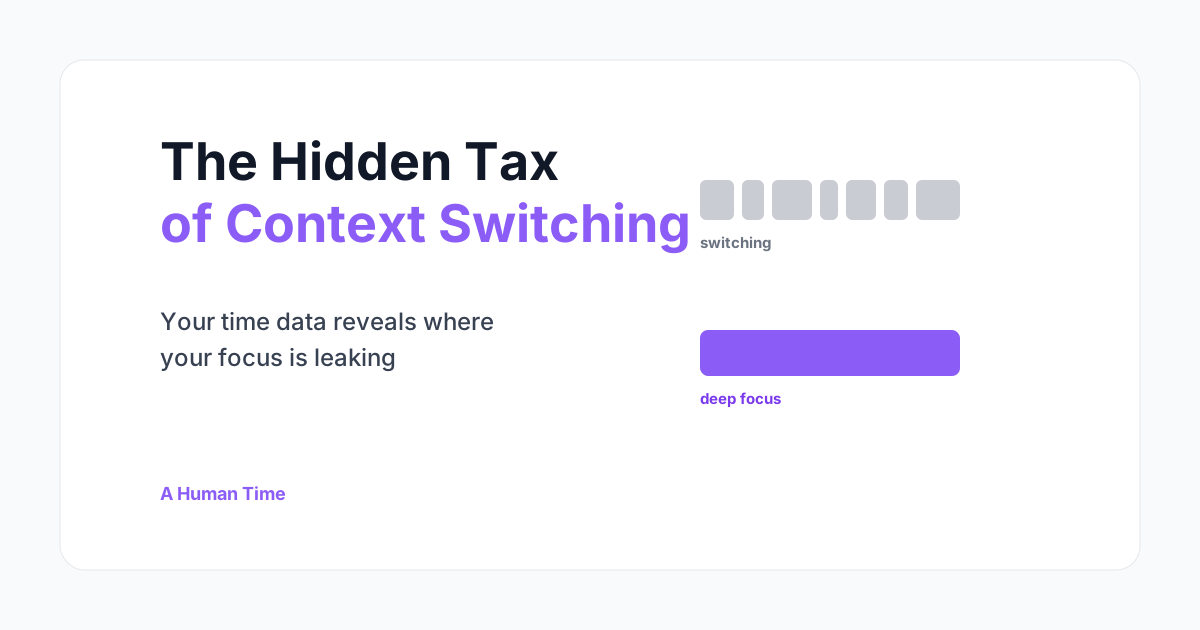
You start writing the proposal. A Slack ping. You answer it. Back to the proposal — wait, what were you saying? Fifteen minutes later you're finally back in the flow, and your calendar chimes for a "quick sync." By 5pm you feel like you worked all day, yet the proposal is still half-finished.
That gap between how hard you worked and how little you finished has a name: the tax of context switching. And it's bigger than almost anyone realizes. Research from UC Irvine found it takes an average of 23 minutes to fully refocus after an interruption, and studies attributed to Atlassian and RescueTime estimate that task switching quietly consumes up to 40% of a knowledge worker's productive time. The cost of context switching isn't the two minutes you spent on Slack — it's the twenty you lost getting back.
The good news: this is one of the few productivity problems you can actually measure. Your own time data reveals exactly where your focus fractures — no manager peering over your shoulder required.
Why Switching Costs So Much More Than It Feels Like
Psychologist Dr. Sophie Leroy described the reason as attention residue: when you jump from one task to another, part of your mind stays stuck on the first one. The harder the task you left, the stronger the residue — which is why bouncing from deep work to a "quick" email drags on your brain far more than the email's length suggests.
So a workday isn't a clean stack of tasks. It's a blurry smear where the edges of every task bleed into the next. You don't just lose the interrupting minute. You lose the ramp-up back into focus, again and again, until "busy" and "productive" stop meaning the same thing.
The problem is that switching feels productive. Answering pings and hopping between projects gives you a hit of momentum. Which is exactly why you can't fix it on gut feel — the feeling lies. You need evidence.
What Your Time Data Actually Shows You
This is where tracked time becomes a diagnostic instead of a report card. When every entry is tied to a task as the work happens, patterns you couldn't feel become obvious on the page:
- Session length. Calculate the average duration of your uninterrupted work blocks for each project. If your "deep work" averages 18-minute fragments, you've found your leak — you're never staying long enough to reach flow.
- Switch frequency. Count how many distinct tasks a single day touches. Ten context switches before lunch is a very different day from three, even if the totals match.
- Time-of-day patterns. Most people have a fragmented window (often mid-afternoon) and a naturally focused one (often early morning). Your data names yours.
- The interruption tax. Compare tasks you finished in one sitting against the same kind of task done in scattered pieces. The scattered version almost always costs more total hours — that difference is the tax, in real numbers.
A Human Time makes this effortless. Because it captures where your hours actually go — as the work happens, not from memory at 6pm — you can see your real focus blocks and switching patterns without reconstructing your day or wondering if the numbers are honest. It's your data, working for you. Start your free trial and let a week of real entries show you where your focus is leaking.
Turning the Data Into Fewer Switches
Once you can see the pattern, the fixes get concrete. Try these, then re-measure the following week to see what actually moved the needle:
- Batch by type, not by urgency. Group similar tasks — all invoicing, all client replies, all design — into single blocks. Batching removes the residue tax because your brain stays in one mode.
- Protect your focused window. Your data will show your best deep-work hours. Defend them: no meetings, notifications off, one task open. Even 90 uninterrupted minutes beats a fragmented four hours.
- Give async a chance to work. Not every ping needs an instant answer. A team that agrees most messages can wait two hours reclaims dozens of switches a day.
- Set a switch budget. If your data says you touch 12 tasks a day, aim for 8 next week. Treat switches like a spend you're trying to trim, and let the numbers tell you if you did.
- End the day with a "landing note." Before you stop a deep task, jot the next step in one line. It shrinks tomorrow's ramp-up and softens attention residue overnight.
None of this is about squeezing more hours out of people. It's the opposite: fewer switches means the hours you already work go further, and the day feels less like drowning. That's the whole point — time data as a tool for your focus, not a leash for someone else's control.
Measuring Progress Without the Micromanagement
Here's the trap to avoid: the moment context-switching data becomes a metric managers use to rank people, everyone games it and the trust evaporates. Focus can't be forced from the outside. It's protected from the inside.
The right way to use this data is personal and voluntary. Individuals watch their own switch counts and focus blocks. Teams look at aggregate patterns — "our afternoons are meeting-shredded, let's protect Tuesday mornings" — not at who switched most. The number that matters isn't a leaderboard; it's whether the work that requires focus is actually getting the focus it needs.
Track that honestly for a month and the story tells itself: longer sessions, fewer switches, and more finished work in the same number of hours. Not because anyone worked harder — because the tax finally went down.
The Bottom Line
Context switching is the most expensive thing on your calendar that never shows up as a line item. You can't budget for a cost you can't see. But a week of honest time data turns the invisible tax into a number — and a number is something you can shrink.
Start by measuring, not by resolving to "focus more." Watch your session lengths and switch counts for one ordinary week, then change one thing and measure again. Your focus is worth protecting. Your data is how you protect it.
Track your time without the micromanagement. A Human Time shows you where your focus fractures and where your best hours hide — so you can reclaim them. No surveillance, no guesswork, just your own data working for you. Try A Human Time free → ahumantime.com
Keep reading:
- Time Blocking + Time Tracking: A Productivity System That Sticks
- Preventing Burnout: What Your Time Data Reveals Before It's Too Late
Want a simple way to start capturing where your hours go? Grab our free timesheet template and track a single focused week — the switching pattern will jump right out.