
Client Time Reports That Build Trust (Instead of Starting Arguments)
Client time reports shouldn't feel like defending an invoice. Learn what a trustworthy report contains, a reusable template, and the reporting cadence that eliminates billing surprises and builds client trust.
Client Time Reports That Build Trust (Instead of Starting Arguments)
Every agency has lived through the same uncomfortable moment: you send the invoice, and the reply is some version of "this seems high — what exactly did we pay for?" Suddenly you're digging through timers, reconstructing a month of work from memory, and defending hours you know you earned but can't cleanly show.
That conversation isn't a billing problem. It's a client time reporting problem. When clients can see where their money went — clearly, in their language, without you scrambling — invoices stop being a negotiation and start being a formality. This is the fourth piece in our agency profitability series, and it closes the loop: you've stopped scope creep, learned to estimate from real data, and set a healthy utilization rate. Now let's turn all that tracked time into reports that actually build trust.
Why Clients Distrust Time Reports (and It's Usually Not About the Hours)
Clients rarely dispute the amount of time. They dispute what they can't understand. A raw export that says "Design — 6.5h" tells a client nothing about the three rounds of revisions, the stakeholder call, or the asset resize that ate the afternoon.
The distrust comes from three gaps:
- No context. Hours without outcomes read like a taxi meter, not a partnership.
- No consistency. A report that looks different every month feels improvised — and improvised feels like padding.
- No timing. A report that only appears attached to an invoice looks like justification after the fact, not transparency in real time.
Close those three gaps and "what did we pay for?" simply stops happening.
What a Trustworthy Client Report Actually Contains
A report clients trust is not a data dump. It's a short, structured story of the work. Include these five elements every time:
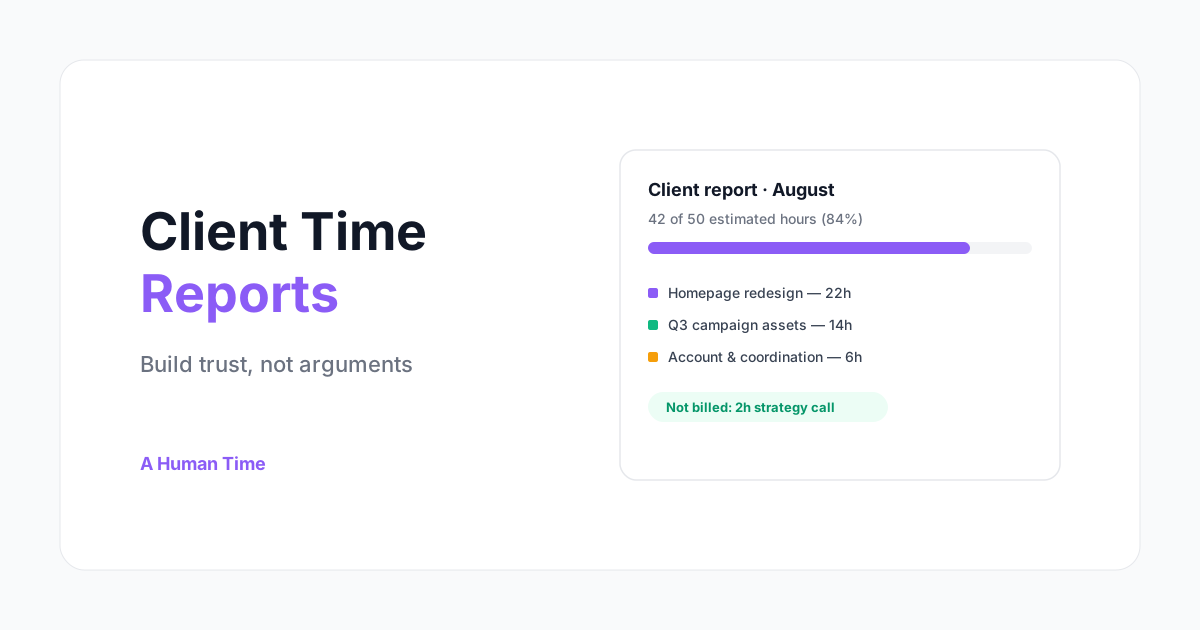
- The headline number in context. Total hours and what percentage of the retainer or estimate that represents. "42 of 50 estimated hours (84%)" is reassuring. "42 hours" alone is not.
- Work grouped by outcome, not by timer. Organize entries under deliverables or workstreams ("Homepage redesign," "Q3 campaign assets") rather than dumping chronological time logs.
- A plain-language note per group. One sentence on what was accomplished and why it took the time it did. This is the single biggest trust-builder — and the thing most tools leave out.
- Billable vs. non-billable made visible. Showing the strategy call or the extra revision round you didn't charge for quietly proves you're being fair.
- Budget status and a forward look. Where the project stands against its estimate, and what's coming next. Surprises kill trust; a heads-up builds it.
A Human Time makes this effortless: because it captures billable and non-billable hours against projects and tasks as the work happens, you can generate a clean, grouped client report in seconds instead of rebuilding one from raw exports at invoice time. The point isn't to surveil your team into logging more — it's to give clients an honest, readable picture of the value they received. Start your free trial and turn your time data into reports that answer questions before they're asked.
A Simple Client Report Template You Can Reuse
Consistency is what turns a report into a habit clients rely on. Use the same structure every reporting cycle:
- Period & summary: "August 1–31 · 42 of 50 estimated hours used (84%)"
- By workstream:
- Homepage redesign — 22h. Completed wireframes, two revision rounds, and dev handoff. Extra round requested mid-project (see budget note).
- Q3 campaign assets — 14h. Delivered 6 social templates and 2 email headers.
- Account & coordination — 6h. Weekly syncs and asset gathering.
- Not billed this period: 2h strategy call — included at no charge.
- Budget status: "84% of estimate used with core scope complete. One added revision round accounts for ~4h; recommend a small change order or absorbing it — your call."
- Next period: "Kicking off blog template design; estimated 12–16h."
Notice the tone: it reads like a partner keeping you informed, not a vendor defending a bill.
Cadence: Report Before the Invoice, Not With It
The most powerful shift is timing. Send a brief progress report mid-cycle — a two-line email at the halfway point of a budget — long before the invoice lands. When a client already knows they're at 60% of the estimate with 70% of the work done, the final invoice contains zero surprises.
A practical cadence:
- Weekly for hourly or high-velocity retainers
- Bi-weekly at the estimate's midpoint for project work
- Monthly as a summary attached to (and reinforcing) the invoice
The goal is that the invoice is never the first time a client hears a number.
Let the Data Defend You
When a dispute does surface, honest tracking is your best advocate. If a client questions an invoice, being able to show grouped, outcome-linked hours — including the work you didn't bill — turns a tense call into a two-minute review. You're not arguing; you're showing.
That only works if the underlying data is complete and captured in the moment. Reconstructed timesheets are exactly what clients (rightly) distrust. Time logged as work happens, tied to real deliverables, is what makes a report credible.
The Bottom Line
Client time reports aren't administrative overhead — they're a relationship tool. Give clients context, consistency, and timing, and reporting stops being the awkward part of the month. It becomes the reason they renew.
Group hours by outcome, add a sentence of plain-language context, show what you didn't charge for, and report before the invoice — not with it. Do that consistently and you'll spend far less time defending your work and far more time doing it.
Track your time without the micromanagement. A Human Time gives you accurate, client-ready reports while treating your team like adults — no surveillance, no scrambling at invoice time. Try A Human Time free → ahumantime.com
Keep reading:
- What Is a Healthy Utilization Rate? A Guide to Capacity Planning Without Burnout
- How to Use Time Tracking to Stop Scope Creep
Building your reporting habit from scratch? Grab our free timesheet template to start capturing the billable and non-billable hours your client reports depend on.