
What Is a Healthy Utilization Rate? A Guide to Capacity Planning Without Burnout
The healthy billable utilization range is 70–85% — high enough to be profitable, low enough to be sustainable. Learn how to calculate yours, set role-based targets, and plan capacity so your team stays profitable without burning out.
What Is a Healthy Utilization Rate? A Guide to Capacity Planning Without Burnout
Here's a number that quietly decides whether your agency is profitable or exhausted: your billable utilization rate. Push it too low and you're leaving revenue on the table. Push it too high and your best people start updating their resumes.
Most agency owners guess at this number. They feel busy, assume everyone is at capacity, and only discover the truth when someone quits or a client complains that quality slipped. A healthy utilization rate isn't a productivity target you crank up — it's a balance point you protect.
Let's break down what a healthy billable utilization rate actually looks like, how to calculate yours, and how to plan capacity so your team stays profitable and human.
What Utilization Rate Actually Measures
Utilization rate is the percentage of an employee's available working hours that are spent on billable client work.
The formula is simple:
Utilization rate = (Billable hours ÷ Total available hours) × 100
If a designer has 40 available hours in a week and logs 30 billable hours, their utilization is 75%. The other 10 hours went to internal meetings, admin, business development, learning, or rest — none of it billable, but almost all of it necessary.
That last point is where most owners go wrong. They see the 25% of "non-billable" time and treat it as waste to be eliminated. It isn't. It's the buffer that keeps the billable work sustainable.
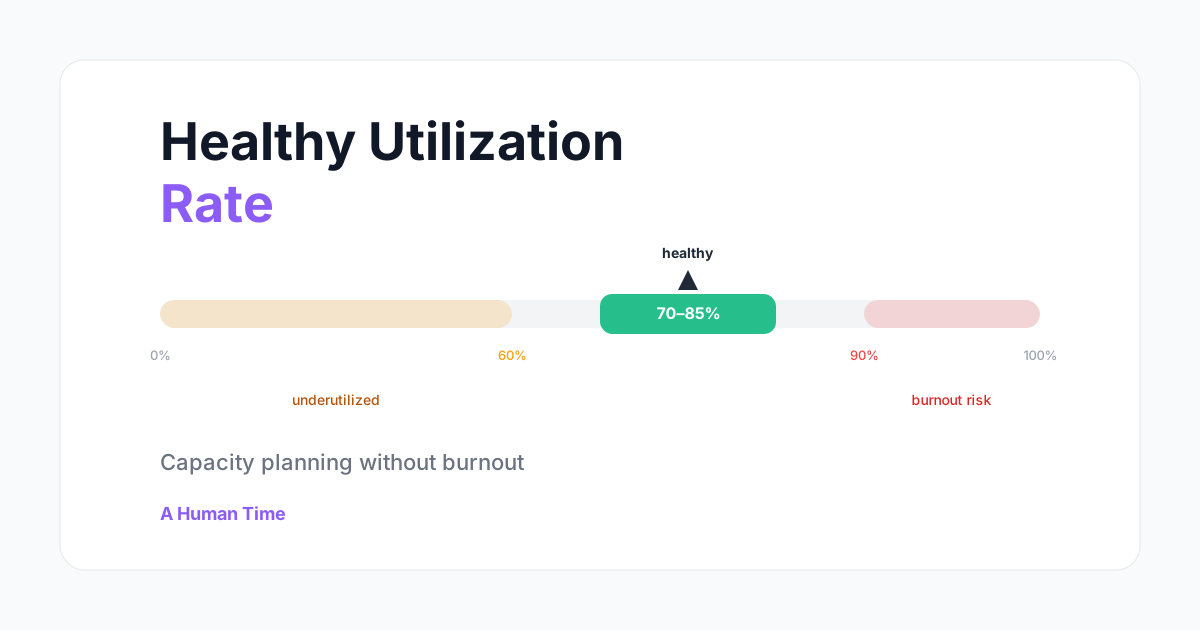
The Healthy Range: 70–85%
Across professional services — agencies, consultancies, studios — the consensus healthy range for billable utilization is 70% to 85%.
Here's why the range matters more than a single number:
- Below 60%: You're likely underpricing, underselling, or overstaffed. There's real revenue you're not capturing.
- 70–85%: The sweet spot. Your team is productive, projects are profitable, and there's deliberate room for the non-billable work that keeps an agency alive.
- Above 90%: Danger zone. Sustained utilization this high almost always leads to burnout, declining quality, and turnover — which costs far more than the extra billable hours earned.
Utilization should also flex by role. A reasonable structure:
- Junior staff: up to 85–90% — more execution, less business overhead
- Mid-level staff: around 80%
- Senior staff: 60–70% — they carry mentorship, strategy, sales, and review
- Blended team target: 70–75%
If you're targeting 100% billable for anyone, you've built a plan with no slack — and a plan with no slack breaks the moment reality shows up.
Why You Can't Manage Utilization Without Accurate Time Data
You cannot calculate — let alone protect — a utilization rate you can't see. And you can't see it from a calendar full of meetings or a gut feeling that "everyone's slammed."
Real utilization data requires capturing all the hours: billable and non-billable, the client work and the invisible work around it. That's the only way to know whether your 80%-utilized senior is genuinely at capacity or spending 30% of their week in avoidable status meetings.
This is exactly the kind of visibility A Human Time is built for. It captures billable and non-billable time in one place, so you can see true utilization per person and per role — without turning your team into subjects of surveillance. The goal isn't to catch people slacking; it's to catch overload before it becomes burnout. Start your free trial and see where your team actually stands.
A Simple Capacity Planning Framework
Once you can see real utilization, planning capacity becomes a repeatable process instead of a monthly panic. Here's a four-step framework.
Step 1: Establish Each Person's True Available Hours
Start from realistic capacity, not theoretical. A 40-hour week is not 40 billable hours. Subtract standing non-billable commitments — team meetings, one-on-ones, admin — to find each person's realistic billable ceiling. For most roles that's 28–34 hours, not 40.
Step 2: Set Role-Based Utilization Targets
Apply the ranges above. Give seniors more slack, juniors more billable load, and set a blended team target of 70–75%. Write these down — an unwritten target is a target nobody manages to.
Step 3: Forecast Demand Against Capacity
Lay your committed and pipeline projects against your team's realistic capacity for the next 4–8 weeks. This is where overbooking hides: three projects that each "only need a few hours from Sam" quietly push Sam to 110%. Seeing it on one view lets you rebalance before the crunch.
Step 4: Review Actuals Weekly and Adjust
Compare planned utilization to actual logged hours every week. If someone consistently runs above 90%, that's a hiring signal or a scope signal — not a "push harder" signal. If someone runs below 60%, redistribute work or reassess pricing.
Reading the Signals Correctly
The whole point of tracking utilization is to make better decisions, not to rank people. Two teams can both average 80% — but one is balanced while the other is masking two people at 95% and two at 65%. Averages lie; distribution tells the truth.
Use utilization as an early-warning system:
- Sustained highs → hire, or say no to the next project
- Sustained lows → sell more, or reassess your rates and staffing
- Wide spread across the team → rebalance workload before your top performers burn out
The Bottom Line
A healthy billable utilization rate — that 70–85% band — is one of the most reliable indicators of a well-run services business. It's high enough to be profitable and low enough to be sustainable. But you can only manage it if you're measuring real time data, and only benefit from it if you treat it as a health signal rather than a productivity whip.
Track the hours honestly, plan capacity against reality, and let the numbers protect your team instead of pressuring them.
Track your team's time without the micromanagement. A Human Time gives you accurate utilization and capacity insights while treating your people like adults. Try A Human Time free → ahumantime.com
Keep reading:
- How to Estimate Projects Accurately Using Historical Time Data
- How to Use Time Tracking to Stop Scope Creep
Want a head start on tracking billable vs. non-billable hours? Grab our free timesheet template and start capturing the data your capacity plan needs.