
How to Optimize Your Consulting Rate Using Time Data
Most consultants set their rate by guessing. Here's how to use time tracking data to calculate your effective rate, identify unprofitable clients, and price with confidence.
Most consultants set their rate once — usually by checking what competitors charge and adding or subtracting a bit based on confidence. Then they leave it unchanged for years, occasionally wondering if they're charging too much or too little.
Here's the thing: your rate should be a data-driven decision, not a feeling. And the data comes from one place — your time tracking records. How many hours you actually work, how many are billable, how much non-billable overhead eats into your effective rate, and which clients give you the best return on your time.
This guide shows you how to use time data to calculate, optimize, and confidently communicate your consulting rate.
The Effective Rate Problem
Quoted Rate vs Effective Rate
Your quoted rate isn't what you actually earn per hour. Your effective rate is.
Effective Rate = Total Revenue ÷ Total Hours Worked
If you charge $200/hour and work 50 hours/week but only bill 30 of those hours:
- Quoted rate: $200/hour
- Revenue: 30 × $200 = $6,000/week
- Effective rate: $6,000 ÷ 50 hours = $120/hour
That gap — $80/hour — represents all the unbilled time: sales, proposals, admin, learning, marketing, and scope creep that never made it onto an invoice.
Most consultants don't calculate this number. And that's why most consultants feel underpaid despite "high" rates.
The Billable Ratio
Billable Ratio = Billable Hours ÷ Total Hours Worked × 100
For independent consultants:
- 80%+ billable: Exceptional (almost no overhead, usually unsustainable)
- 65-75% billable: Healthy (some admin, marketing, and development time)
- 50-65% billable: Normal (significant sales/marketing or between-engagement gaps)
- Below 50%: Unsustainable (either feast/famine cycles or too much non-revenue work)
If your billable ratio is 60%, your quoted rate needs to be 67% higher than your target effective rate to compensate.
Calculating Your Minimum Rate
The Revenue-Back Approach
Start with what you need to earn, then calculate backward:
Step 1: Target annual income Include: salary equivalent + benefits value + retirement contributions + taxes + profit margin
Example: $200,000 total comp target
Step 2: Available billing hours
- 52 weeks × 5 days = 260 work days
- Minus: holidays (10), vacation (15), sick (5) = 230 work days
- Hours per day: 8 = 1,840 total hours
- Billable ratio: 65% = 1,196 billable hours
Step 3: Minimum rate $200,000 ÷ 1,196 = $167/hour minimum
That's the floor. If you charge less, you won't hit your income target given realistic overhead.
Adjusting for Reality
The calculation above assumes 65% utilization. But what does your actual data show?
Track for 3 months:
- Total hours worked per week
- Billable hours per week
- Revenue per month
- Admin/overhead hours per week
Then recalculate with real numbers. Most consultants discover their actual billable ratio is lower than assumed — which means their rate needs to be higher.
Using Time Data to Optimize Your Rate
Analysis 1: Client Profitability
Not all clients are equal. Track time per client and calculate the effective rate for each:
Client Effective Rate = Revenue from Client ÷ Total Hours Spent on Client (including unbilled)
Include in "total hours":
- All billed hours
- Unbilled prep and research
- Scope creep (extra revisions, "quick questions")
- Sales and proposal time
- Administration (invoicing, chasing payment)
When you see the breakdown:
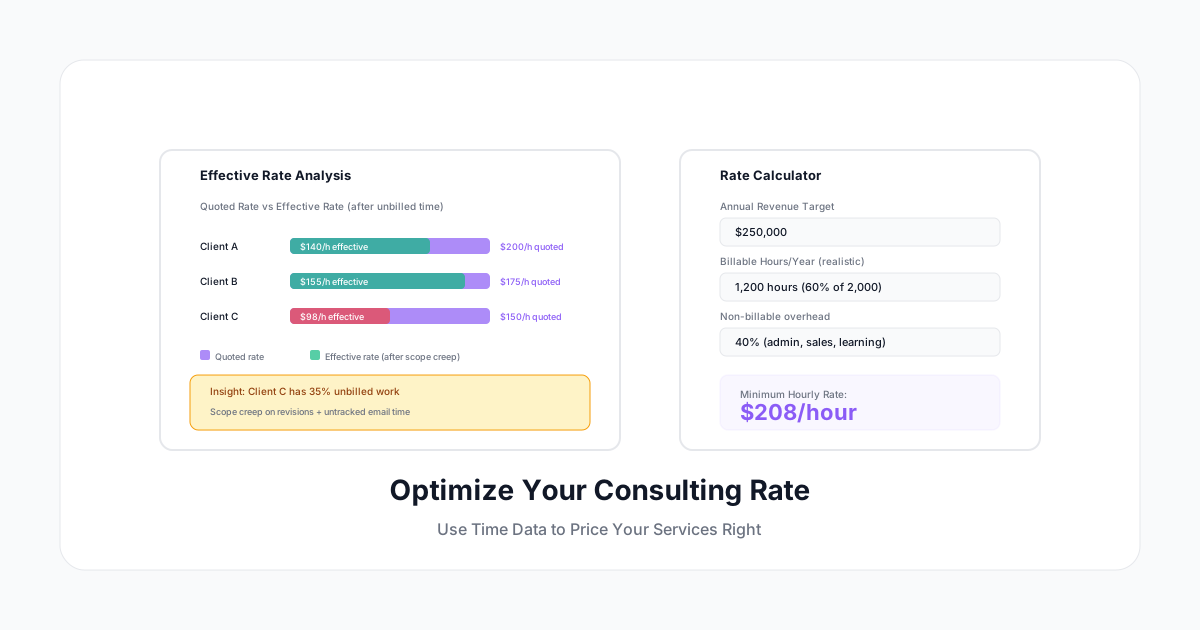
- Client A: $200/hour billed, effective rate $185/hour ← great client
- Client B: $175/hour billed, effective rate $140/hour ← decent
- Client C: $150/hour billed, effective rate $95/hour ← losing money
Client C requires action: raise rate, reduce unbilled work, or fire the client.
Analysis 2: Service Line Profitability
Different service types have different overhead:
| Service | Quoted Rate | Unbilled Overhead | Effective Rate |
|---|---|---|---|
| Strategy consulting | $250/h | Low (15%) | $212/h |
| Implementation | $200/h | Medium (25%) | $150/h |
| Training/workshops | $300/h | High (40%) | $180/h |
| Ongoing advisory | $175/h | Very low (10%) | $158/h |
Training looks highest-rate but prep time makes it lower effective rate than advisory work. This informs which services to sell more of.
Analysis 3: Scope Creep Quantification
Track all work you do for a client — including the "quick favors" you don't bill for.
Scope Creep Rate = Unbilled hours ÷ Billed hours × 100
- Under 5%: Excellent boundaries
- 5-15%: Normal for relationship maintenance
- 15-30%: Problematic — you're doing significant free work
- Above 30%: Unsustainable — needs immediate contract renegotiation
Analysis 4: Rate vs Demand
If you're at 90%+ utilization for more than 2 months, your rate is too low. You're at capacity — demand exceeds supply. Raise your rate.
If you're below 50% utilization for more than 2 months, either your rate is too high for your market, or your sales/marketing needs work (not necessarily a rate problem).
The sweet spot: 65-80% utilization. Enough room for non-billable work and the ability to take on good opportunities when they arise.
Rate Adjustment Strategies
Strategy 1: New Client Pricing
The easiest rate increase: charge new clients more. Existing clients stay at current rate until renewal.
- No awkward conversations with current clients
- New rate validates in the market
- Gradually your average rate rises as new clients replace old
Strategy 2: Annual Rate Reviews
Build rate increases into your client agreements:
- "Rate reviewed annually with 30-day notice"
- Typical increase: 5-10% per year (matching inflation + experience gain)
- Time data supports the conversation: "My effective rate on your account has actually decreased 12% due to increased scope — I need to adjust"
Strategy 3: Value-Based Pricing (Informed by Time Data)
Use historical time data to price by value rather than hours:
- "This type of project has historically taken me 40 hours. I'll price it at $12,000 fixed fee."
- If you complete it in 30 hours, your effective rate jumps to $400/hour
- If it takes 50, you're at $240/hour (still acceptable)
Time data makes value pricing possible because you know what "typical" looks like.
Strategy 4: Rate Tiers by Activity
Different activities warrant different rates:
- Strategy and advisory: $300/hour (high expertise, high value)
- Execution and implementation: $200/hour (skilled labor, moderate leverage)
- Administrative and coordination: Built into overhead (never bill separately at a lower rate)
Strategy 5: Minimum Engagement Size
Track average client engagement size. If most clients need 20+ hours:
- Set minimum engagement: 10 hours/month
- Prevents small clients from eating disproportionate admin time
- Improves your effective rate on small accounts
Building Your Rate Confidence
Time data eliminates the guesswork. When you can show:
- "My average project saves clients $X in efficiency gains" (value justification)
- "My effective rate, including all overhead, needs to be $Y to sustain my business" (cost justification)
- "Clients at my current rate have a 95% renewal rate" (market justification)
- "My utilization is at 85%, indicating strong demand" (supply/demand justification)
...you never have to wonder if your rate is "right." The data tells you.
Rate Communication Tips
When a Client Pushes Back on Rate
- "I understand budget is a consideration. Based on my time data from similar projects, the total investment will be [X hours × rate]. Here's what that delivers..."
- Never compete on rate alone. Compete on: speed, quality, reliability, expertise, and the fact that your time data proves you deliver predictably.
When Raising Rates
- "Based on my analysis of the work we've done together, my effective rate on your account has been significantly below my standard rate due to [scope expansion / unbilled coordination / etc]. I'm adjusting to $X effective [date]."
- Provide 30-60 days notice
- Show the data if asked (hours spent vs hours billed)
When Quoting New Projects
- "Based on similar projects in my portfolio, I expect this to require 35-45 hours. At my rate of $X, the total investment is $Y-$Z. I'll track actual time and invoice based on actuals (or fixed at mid-range)."
- Historical time data makes your estimates credible, not aspirational.
Getting Started
- Track everything for 30 days. All hours — billable, admin, sales, learning, breaks.
- Calculate your real numbers. Effective rate, billable ratio, client profitability.
- Identify the gap. Where is time going that isn't generating revenue?
- Set your target rate. Based on your income goal and realistic billable hours.
- Adjust. Raise rates for new clients, reduce unbilled work for existing clients, fire unprofitable clients.
- Re-evaluate quarterly. Markets change. Your value changes. Your rate should too.
A Human Time gives consultants the data they need to price with confidence: per-client profitability reports, billable ratio dashboards, scope creep tracking, and effective rate calculations that update in real time. Because your expertise is worth what the data says it's worth — not what imposter syndrome tells you.
Track your time. Know your numbers. Price with confidence.